
AI meeting assistants are easy to compare on feature lists. They are harder to compare when you ask whether the summary captured the decision that actually mattered, whether the right person owns an action item, or whether AI Chat can retrieve something discussed 40 minutes into a call.
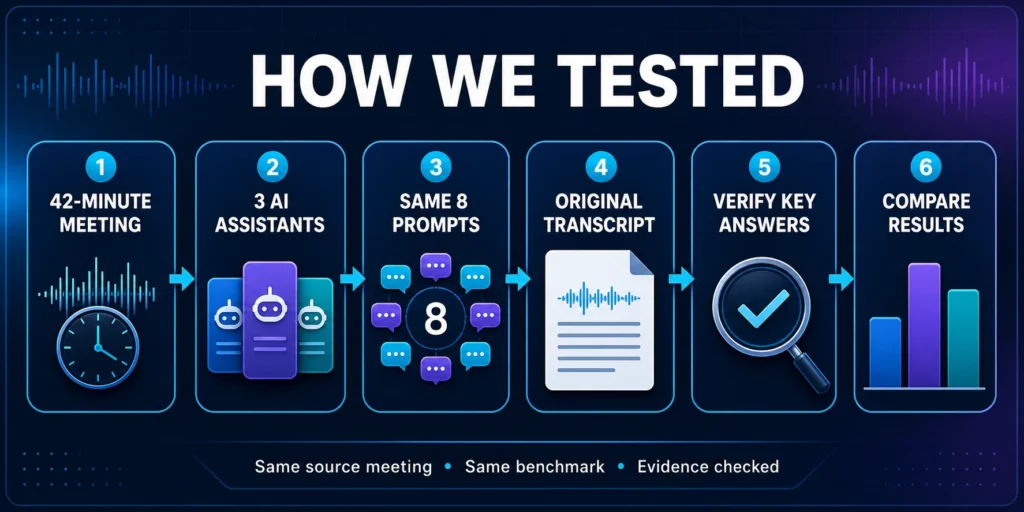
We tested Fireflies AI, Otter AI, and MeetGeek using the same roughly 42-minute, multi-speaker meeting and the same eight AI Chat prompts. We then checked key answers against the original meeting transcript instead of assuming the AI output was correct.
Fireflies AI ranked first overall in our test. But all three handled basic meeting notes reasonably well. The meaningful differences appeared when we tested final decisions, action-item ownership, long-meeting retrieval, and missing information.
Disclosure: We may earn a commission if you purchase through some links in this article, at no additional cost to you. Commercial relationships did not determine our test method, scores, rankings, or awards.
Best AI meeting assistants: our verdict
Fireflies AI was the best overall performer among the three meeting assistants we tested. It gave us the strongest balance of meeting coverage, summary quality, action-item handling, AI Chat, and free-plan value. Otter AI stood out for source-grounded Chat responses, while MeetGeek was particularly useful for occasional longer meetings on its free plan.
| Award | Winner |
|---|---|
| Best overall | Fireflies AI |
| Best source-grounded AI Chat | Otter AI |
| Best free plan for occasional longer meetings | MeetGeek |
| Test setup | Same ~42-minute meeting + 8 identical AI Chat prompts |
The best AI meeting assistants at a glance
| Tool | Best for | Score | What stood out in our test |
|---|---|---|---|
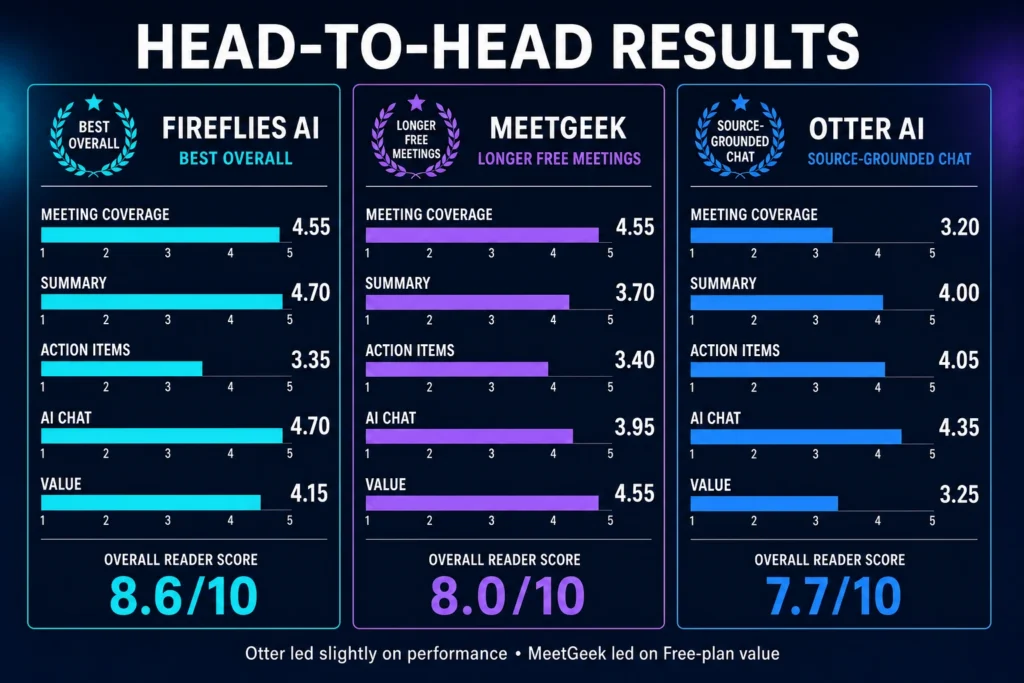
| Fireflies AI | Best overall | 8.6/10 | Strongest overall balance, led by coverage, summary, and AI Chat |
| MeetGeek | Occasional longer Free meetings | 8.0/10 | Strong full-meeting coverage and value; one historical Chat miss but 3/3 correct repeats |
| Otter AI | Source-grounded AI Chat | 7.7/10 | Strong grounding, but Basic meeting coverage affected our 42-minute test |
Note: These scores reflect our five-part benchmark, not every feature each product offers.
MeetGeek and Otter were separated by about 0.35 points out of 10, a small difference in our scoring system. MeetGeek ranked higher because its Basic plan covered the full benchmark meeting and offered stronger value for this use case; Otter remained slightly stronger on performance-only output and source-grounded Chat on the context available to it.
How we tested these AI meeting assistants
To compare the best AI meeting assistants under consistent conditions, we used the same approximately 42-minute business meeting for all three tools. It included multiple speakers, technical terminology, action items, competing proposals, and an explicit final messaging decision near the end. Speaker identities were anonymized for privacy.
We then ran eight equivalent AI Chat tests covering:
summary → action items → final-decision retrieval → post-30-minute retrieval → technical entities → hallucination control → follow-up writing → contextual follow-up.
Finally, we checked key claims against the original meeting transcript.
How scoring works
| Test area | Weight |
|---|---|
| Transcript usability & meeting coverage | 20% |
| Summary quality | 20% |
| Action items | 20% |
| AI Chat / Q&A | 25% |
| Pricing & value | 15% |
We only scored areas where we had sufficiently comparable evidence across all three tools. Integrations, privacy controls, sharing, and other features are discussed where relevant but are not included in the numerical score.
Atomic tests were graded on a 1–5 scale. Weighted component results produced decimal dimension scores, and the five dimensions produced the final score. We calculated with unrounded values and rounded reader-facing product scores to one decimal place.
| Dimension | Fireflies | MeetGeek | Otter |
|---|---|---|---|
| Transcript usability & meeting coverage | 4.55 | 4.55 | 3.20 |
| Summary quality | 4.70 | 3.70 | 4.00 |
| Action items | 3.35 | 3.40 | 4.05 |
| AI Chat / Q&A | 4.70 | 3.95 | 4.35* |
| Pricing & value | 4.15 | 4.55 | 3.25 |
* Otter’s post-30-minute Chat prompt was N/A because the required source context was unavailable on Basic. We normalized the remaining applicable prompt weights and scored the root coverage limitation only under meeting coverage and value.
After the original eight-prompt benchmark, we repeated the two highest-risk checks three times per product: the final-decision prompt and the nonexistent-budget prompt. Fireflies and Otter returned the correct final decision in all three repeats. MeetGeek also answered all three repeats correctly, although we retained its contradictory original run in the evidence record and scored that prompt 4/5 rather than 5/5. All three products rejected the false-budget premise in every repeat.
We did not calculate a transcription “accuracy percentage.” That would require a manually corrected word-for-word reference transcript and a defined error metric. Our original transcript was used to verify decisions, actions, and facts—not to produce a scientific transcription-accuracy claim.
What happened in our head-to-head test?
Transcript usability and meeting coverage
All three products produced transcripts that were usable for reviewing the meeting, generating summaries, and asking follow-up questions.
Fireflies and MeetGeek retained enough of the 42-minute meeting for their assistants to retrieve information from the later discussion. This mattered because the meeting’s final messaging decision appeared near the end rather than in the opening section.
Otter presented a different situation. In our Free-plan test, the transcript available to Otter Chat ended around the 30-minute mark. When we asked what happened later, Otter stated that the necessary source material was unavailable instead of filling the gap with a plausible-sounding answer.
That was good AI behavior, but it exposed a practical product limitation: an assistant cannot reliably retrieve meeting context it never received.
We did not describe this as worse transcription accuracy. It was a meeting-coverage limitation in the Free-plan context we tested, and we counted that root limitation only once rather than using it to penalize Otter’s reasoning again.
Summary quality
Fireflies produced the strongest overall summary in our test. It captured the main event-planning discussion, announcement strategy, product prioritization, competitive-comparison work, and the final “More speed, less risk” positioning.
Otter also produced a useful, detailed summary of the meeting material available to it. It covered event planning, announcement strategy, prioritization, and competitive-analysis work.
MeetGeek’s summary was useful but exposed an important difference between finding information and interpreting its significance. It captured much of the product-announcement discussion but did not clearly preserve the final messaging decision in its main conclusion.
Test finding: A summary can capture most discussion topics and still miss the decision that matters most.
The original transcript shows the meeting leader explicitly choosing “More speed, less risk.” MeetGeek retrieved the phrase but misclassified its status in the original benchmark run. We later repeated the same prompt three times, and all three repeats correctly identified it as the agreed tagline. We preserved the original miss in our score rather than replacing it with the later results.
Action items
Action-item extraction sounds straightforward until several people discuss work without explicitly assigning it. That happened repeatedly in our test meeting.
Fireflies found relevant work, but its first action table put discussion timestamps in the deadline column and missed some ownership cues. A follow-up explanation correctly clarified that those timestamps represented where an item was discussed rather than a due date.
Otter produced a clean seven-item structure, but sometimes treated the speaker discussing a task as its owner even when the transcript did not explicitly assign responsibility that way.
MeetGeek found useful actions but showed a broader tendency to infer owners such as the PMM team or meeting attendees when ownership was less explicit than the answer implied.
Speaker attribution is not the same as task ownership.
For important follow-ups, we would still verify AI-generated owners and deadlines before pushing them into a project-management platform or CRM.
AI Chat and meeting retrieval
The easiest prompts did not separate the three products very much. All could summarize the meeting, generate follow-up content, answer a contextual follow-up, and reject our deliberately false budget premise.
The more demanding tests revealed clearer differences.
| AI Chat test | Fireflies | Otter | MeetGeek |
|---|---|---|---|
| Meeting summary | Strong | Strong | Good |
| Final decision | Pass | Pass | Partial |
| After minute 30 | Pass | Source unavailable on our Free test | Pass |
| Technical/source grounding | Strong | Strongest in our test | Strong |
| False budget prompt | Pass | Pass | Pass |
| Contextual follow-up | Pass | Pass | Pass |
What was the final decision?
The original meeting transcript shows that the team ultimately chose:
More speed, less risk.
Fireflies found the phrase and correctly interpreted it as the final positioning statement. Otter also returned the same final phrase.
MeetGeek’s original run retrieved the phrase but concluded that no single final tagline had been formally locked. The source transcript supported a stronger conclusion. In three later repeats of the same prompt, MeetGeek correctly described “More speed, less risk” as the agreed tagline each time.
What happened after minute 30?
Fireflies retrieved later discussion about the infographic and messaging work. MeetGeek also performed strongly, returning timestamped information extending into the final minutes.
Otter could not complete the same retrieval because the source available to Chat in our Free-plan test ended around 29:30. Importantly, it disclosed the gap rather than guessing.
Could we make the assistants invent an approved budget?
No.
There was no approved budget in the source meeting. Fireflies, Otter, and MeetGeek all correctly rejected the premise instead of inventing an amount or approver.
None of the three assistants invented a budget when we deliberately asked about one that did not exist. Each also rejected the false premise in all three repeat runs. This does not prove that the products never hallucinate, but the result was stable on this specific control.
Pricing and free-plan value
Pricing and plan limits change more often than hands-on meeting results. The figures below were checked against official vendor sources on August 13, 2026 and should be refreshed before a future update.
Fireflies AI pricing
Fireflies offers a Free plan with unlimited transcription, unlimited AI summaries, and 400 minutes of storage per team. New Free accounts receive a limited number of AI credits for advanced features.
Its paid annual pricing currently starts at:
- Pro: $10 per seat/month, with 8,000 minutes of storage per seat.
- Business: $19 per seat/month, with unlimited storage.
- Enterprise: $39 per seat/month, billed annually.
For our benchmark use case, Fireflies delivered the strongest combination of free access and full-meeting usefulness. Storage and advanced AI usage remain limited even when transcription is unlimited.
Otter AI pricing
Otter Basic includes 300 monthly transcription minutes. The individual-conversation limit on the Free account affected our 42-minute benchmark because the Chat-accessible transcript ended around minute 30.
Otter currently advertises Pro at $8.33 per user/month billed annually, including 1,200 monthly transcription minutes and expanded AI Chat. Business is listed at $20 per user/month billed annually.
The paid value may be attractive when its longer-meeting allowances fit the buyer’s workflow, but plan selection materially changes how much meeting context is available for later retrieval.
See current Otter plan information
MeetGeek pricing
MeetGeek Basic is free and currently includes:
- 3 hours of transcription per month;v
- meetings up to 2 hours each;
- unlimited AI summaries;
- Global Search and AI Chat;
- 3 months of transcript storage and 1 month of audio storage.
Pro is listed at $9.99 per user/month with 20 transcription hours per month. Business is listed at $17 per user/month, with unlimited transcription and meetings up to three hours.
That makes the Basic plan particularly interesting for people who have relatively few meetings but need more room within an individual meeting.
1. Fireflies AI — Best Overall
Our score: 8.6/10
Fireflies ranked first because it produced the most balanced results across the areas we measured—not because it won every possible feature comparison.
Its strongest result came from combining full-meeting context with reliable retrieval. It found the final “More speed, less risk” decision, retrieved information from the later discussion, rejected our false budget premise, and produced usable follow-up content.
Its action-item result required more review than its overall score might suggest. The first table mislabeled discussion timestamps as deadlines and missed some ownership cues, although a follow-up explanation correctly distinguished timestamps from due dates. Fireflies still avoided some of the broader group-owner inferences we saw elsewhere.
Fireflies was not perfect. Technical wording still deserved review, and AI-generated owners or deadlines should not be accepted blindly. Its Free plan also places limits around storage and advanced AI usage even though standard transcription and summaries are currently available without a transcription cap.
Choose Fireflies AI if you want the most balanced performer from our three-way test and expect to use transcripts, summaries, action items, and AI Q&A rather than relying on one feature alone.
For the complete product-level evidence and limitations, read our hands-on Fireflies AI review. For current plan economics beyond this benchmark, see the Fireflies AI pricing guide.
2. MeetGeek — Best Free Plan for Occasional Longer Meetings
Our score: 8.0/10
MeetGeek’s biggest strength in our test was simple but important: it retained enough context to work with the entire meeting.
When asked specifically about discussion after minute 30, MeetGeek returned detailed, timestamped information extending into the final section. Its Basic plan also supports up to three transcription hours per month and meetings up to two hours each, making it attractive for occasional longer meetings.
Where MeetGeek lost points was consistency across the full evidence record.
In the original benchmark run, it retrieved “More speed, less risk” but said that no final tagline had been formally locked. Three later runs of the same prompt all correctly identified that phrase as the agreed tagline. We therefore raised its Prompt 3 score from 3 to 4, while retaining the historical error as a limitation.
We also found that some generated action owners and deadlines deserved verification. These were not catastrophic errors. They were examples of why a polished AI answer should not automatically be treated as the definitive meeting record.
Choose MeetGeek if you have occasional longer meetings, want more room per meeting on a free plan, and value retrieval across the full conversation.
For a deeper look at its transcript, summary, insights, and Chat behavior, read our hands-on MeetGeek review.
3. Otter AI — Best Source-Grounded AI Chat
Our score: 7.7/10
Otter produced some of the strongest source-grounded Chat responses in our test.
Its handling of technical entities was particularly useful, it correctly retrieved the final positioning statement, and it passed our hallucination-control prompt cleanly.
The main issue came from Basic-plan meeting coverage rather than the quality of the Chat response itself.
In our Basic-plan test, Otter Chat told us that the transcript available to it ended around 29:30, so it could not reliably answer questions about the remainder of the 42-minute meeting.
That result represents both a weakness and a strength. It is a product limitation because part of our meeting was unavailable for later retrieval. But it is good AI behavior because Otter did not pretend to know what happened.
Otter becomes more practical for longer meetings when a paid plan provides enough per-meeting coverage. Buyers should check the current duration and usage allowances rather than assuming that the Basic-plan experience represents every Otter plan.
Choose Otter AI if source-grounded AI Chat matters most and your meeting duration fits the limits of the plan you are considering.
For the complete Basic-plan test, transcript-limit evidence, and Chat evaluation, read our hands-on Otter AI review.
Fireflies vs Otter vs MeetGeek: Which should you choose?
Choose Fireflies AI if you want the most balanced option from our test and expect to use summaries, action items, and AI Chat regularly.
Choose Otter AI if source-grounded AI Chat matters most and your meeting duration fits the limits of your chosen plan.
Choose MeetGeek if you have occasional longer meetings and want more room per meeting on a free plan.
None of those recommendations means the other two are poor meeting assistants. The three products were closer on basic tasks than their final scores might suggest. The differences between these best AI meeting assistants appeared when the benchmark moved beyond ordinary summary generation.
MeetGeek and Otter remained close in the aggregate. Their order should be read primarily as a buyer-fit distinction: Otter scored slightly higher when we excluded pricing and value, while MeetGeek’s full-meeting Basic coverage lifted its overall buyer score.
What we learned from testing AI meeting assistants
A good summary can still miss the decision that matters
A summary is a compressed interpretation of a meeting, not simply a list of extracted sentences. That makes prioritization important.
MeetGeek covered much of the discussion, but its main summary did not preserve the final messaging decision as clearly as Fireflies did. Its original Chat run also interpreted the status too cautiously, although three later repeats classified the decision correctly.
Summary is not the same as decision understanding.
Finding a task is easier than assigning its owner
All three products could identify useful follow-up work. The harder question was whether the meeting had actually assigned each task to the person named by the AI.
A speaker can propose, explain, or repeat a task without accepting responsibility for it. The safest product behavior is to preserve uncertainty instead of converting every speaker label into an owner.
Speaker attribution is not the same as task ownership.
Missing context can matter more than hallucination
All three assistants passed our false-budget prompt. None invented a budget or approver.
The more noticeable problems came from incomplete context and interpretation. Otter correctly refused to describe a part of the meeting it could not access. MeetGeek’s original run had the source phrase but interpreted its status differently from the reference transcript; later repeats answered correctly, showing why a single run should not be treated as permanent product behavior.
Missing context is not the same as hallucination.
Frequently asked questions
What is the best AI meeting assistant?
Fireflies AI was the best overall option among the three products in our benchmark. It produced the most balanced combination of full-meeting coverage, summary quality, action-item handling, AI Chat, and value. The best choice for you may differ if source-grounded Chat or longer individual meetings on a free plan matters more.
What is the best free AI meeting assistant?
Fireflies offered the strongest overall free-plan value in our test because it combined unlimited transcription with useful summaries and full coverage of our 42-minute meeting. MeetGeek was especially attractive for occasional longer meetings because its Basic plan allowed up to two hours per meeting, subject to a three-hour monthly transcription allowance.
Is Fireflies better than Otter?
Fireflies ranked higher in our five-part benchmark and was the more balanced choice. Otter produced some of the strongest source-grounded Chat answers, but the Basic-plan meeting limit affected how much of our 42-minute test its Chat could retrieve. The better choice depends on your plan and meeting length.
Are AI meeting assistants accurate?
They can produce useful transcripts, summaries, action items, and answers, but important outputs still require review. In our test, the biggest risks were not invented facts. They were missing meeting context, misreading whether a proposal became a decision, and inferring an action owner from the person speaking.
Final verdict
Fireflies AI ranked first among the three AI meeting assistants we tested, with the most balanced performance across meeting coverage, summaries, action items, AI Chat, and value.
MeetGeek retained the full meeting and performed well on deep retrieval, although some decisions and action owners needed closer review. Otter AI produced some of the strongest source-grounded Chat responses, but the Basic-plan meeting limit affected how much of our 42-minute test its Chat could retrieve.
More importantly, all three handled basic meeting notes reasonably well. The differences appeared when we asked harder questions: What was actually decided? Who really owns the task? And does the AI have enough meeting context to answer at all?
Those are the questions we would use when choosing among the best AI meeting assistants for a real workflow.